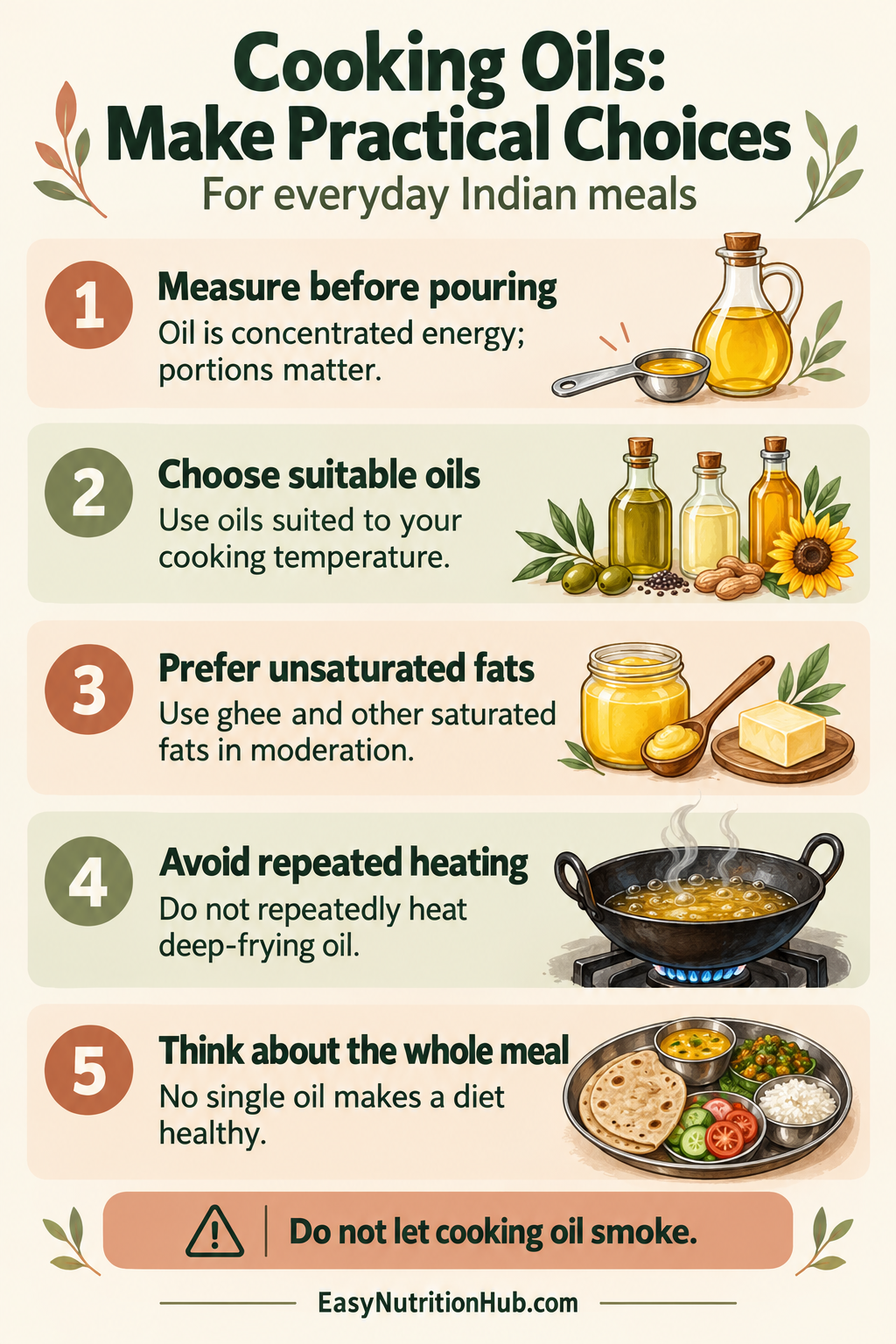
Key takeaways: Choose oils suited to your cooking method, use measured amounts and avoid repeated high-temperature heating. No single oil makes an otherwise unbalanced diet healthy.
By Dr. Sonal Gupta Jain
PhD, Public Health Nutritionist | Co-Founder, EasyNutritionHub.com
It was just another day at the grocery store. I spotted a man carefully surveying the array of cooking oils on the shelf. I walked over and asked out of curiosity, “What made you pick that one?”
He held up the bottle, smiled, and said, “The price seemed okay.”
While I was initially thrilled to see someone engaging with the labels, I quickly realized it wasn’t for the nutritional profile—it was the cost that sealed the deal.
This moment stayed with me.
Because ever since I completed my education in nutrition, one question I’m asked more than any other is: “Which oil is the healthiest?”
As Delhi wakes up to a rainy Sunday, and the scent of fried pakoras and bubbling chole bhature fills the air, we all know what’s next—a crispy indulgence is practically mandatory. And that’s okay. But how we fry, what oil we use, and how we balance it can make all the difference.
Let’s break it down.
Why Cooking Oil Deserves Your Attention
Cooking oils are not just carriers of taste—they are concentrated sources of fat, calories, and bioactive compounds. Overconsumption, poor oil choices, and reusing oils improperly can lead to a range of health issues including chronic inflammation, fatty liver, insulin resistance, and more.
Understanding Fat Types (Simplified)
- Saturated fats (e.g., desi ghee, coconut oil, palm oil): Can raise LDL (bad) cholesterol if consumed in excess.
- Monounsaturated fats (MUFA) (e.g., mustard, olive oil, canola oil): Heart-protective and anti-inflammatory.
- Polyunsaturated fats (PUFA) (e.g., sunflower, soybean oil): Good in moderation, but need a balance between omega-6 and omega-3.
- Omega-3 fats: Flaxseed and walnuts provide ALA; oily fish provides EPA and DHA. Olive oil is mainly a source of monounsaturated fat, not a major omega-3 source.
- Omega-6 fats: These are essential polyunsaturated fats. Include omega-3 sources too; omega-6-rich oils should not be described as inherently inflammatory.
- Trans fats: Formed during repeated frying, and commonly found in margarine and commercial baked goods—major contributors to heart disease.
- Want a detailed post on types of fats? Comment below and I’ll create a deep-dive post soon.
🔹 National Guidelines on Fat Intake
Daily visible fat intake should be 25g/day (approx. 5 tsp) for a sedentary adult.
Oils, butter, ghee, vanaspati – all included in this.
Teaspoon tip: 1 tsp = ~5g oil = 45 kcal; 5 tsp/day = ~225 calories just from fat.
Key recommendation: Blend of oils (MUFA + PUFA), low saturated fats, avoid trans fats.
Do not reuse oil repeatedly – leads to trans fat formation, production of toxic compounds.
Even our Hon’ble Prime Minister Shri Narendra Modi has urged the nation to reduce edible oil intake and make healthier dietary choices under the Eat Right India movement—a powerful public health vision.
🧚 What the Science Says: Oil vs Health
| Oil Type | Major Component | Health Impact |
|---|---|---|
| Mustard Oil | MUFA, ALA | Anti-inflammatory, heart protective |
| Groundnut Oil | MUFA + Vitamin E | Stable for high-heat cooking |
| Sunflower Oil | PUFA (Omega-6) | Requires omega-3 balance |
| Rice Bran Oil | Oryzanol, MUFA | Lowers cholesterol |
| Soybean Oil | PUFA | Rich in essential fats |
| Olive Oil (EVOO) | MUFA | Best for salads, not frying |
| Coconut Oil | Saturated Fat | Use in moderation |
| Palm Oil | Saturated Fat | Linked to heart risk |
| Desi Ghee | Saturated Fat + CLA | Use moderately |
| Butter | Saturated Fat | High in cholesterol |
All data aligned with WHO/FAO Guidelines, NIN Dietary Guidelines & Codex Alimentarius.
Choosing Right: Practical Oil Wisdom
Statement: Rotate oils every 4–6 weeks.
Tip: No single oil meets all needs. Rotation ensures essential fatty acid diversity.
(Sample shared later in the post)
Statement: Use cold-pressed oils for sautéing and dressings.
Hack: Cold-pressed oils retain antioxidants and phytonutrients—perfect for light cooking.
Practical tip: Choose oil suitable for the cooking temperature and avoid letting it smoke. Do not repeatedly heat deep-frying oil or reuse oil that has darkened, foamed or developed an off smell.
Statement: Discard oil that becomes frothy, sticky, smells burnt, or turns dark.
Why: These signs indicate formation of Acrolein (a respiratory irritant), Trans fats, and PAHs (Polycyclic Aromatic Hydrocarbons)—linked to cancer.
Practical tip: Use measured amounts of suitable unsaturated oils as part of a balanced dietary pattern. Diabetes and heart disease require individual advice; no single oil reliably prevents post-meal glucose rises.
🌧️ Rainy Day Realities & Smarter Indulgences
When it rains, Indian kitchens come alive with pakoras, bhaturas, samosas, pooris. Celebrate, but smartly:
- Add grated veggies (lauki, spinach, cabbage) to batter
- Use fresh mustard oil for frying
- Fry on medium heat and avoid overcrowding
- Serve with raw chutneys, lemon water, or curd
- Add salad or moong sprouts to the thali
- Don’t store or reheat fried food—consume fresh
Try making air-fried versions (occasionally), or use a besan + suji mix for crispier, lighter pakoras. Recipies coming soon!
⚠️ Health Fallout of Oil Overload (with Science!)
- When it rains, Indian kitchens come alive with pakoras, bhaturas, samosas, pooris. Celebrate, but smartly:
- Add grated veggies (lauki, spinach, cabbage) to batter
- Use fresh mustard oil for frying
- Fry on medium heat and avoid overcrowding
- Serve with raw chutneys, lemon water, or curd
- Add salad or moong sprouts to the thali
- Don’t store or reheat fried food—consume fresh
- Try making air-fried versions (occasionally), or use a besan + suji mix for crispier, lighter pakoras. Recipies coming soon!
🛒 Label Literacy: Read Before You Drizzle
✅ Look for: Cold Pressed, Expeller Pressed, Omega-3 rich blends
❌ Avoid: Partially Hydrogenated, Added Preservatives, Anti-foaming agents
🔥 Check: Smoke Point >200°C for frying oils
📲 Use: FSSAI’s Eat Right India label scanner
💪 From My Kitchen to Yours: My Oil Plan (Weekly Rotation)
- Mustard oil for dry vegetables and tadkas
- Groundnut oil for poha, chilla, dosa ( rotation needed )
- Rice bran oil, peanut oil (oil with high smoking point) for rare deep frying
- Olive oil for salads, light sautés
- Desi ghee (moderation) for chapati, khichdi, dals
- Note: No “extra ghee” or “ghee-parantha” logic. Ghee is a glow-giver only when taken in moderation. Most high-fat diet fans work out intensely to balance it out. Excess is excess.
🏥 Oil & Public Health: A National Concern
India’s average oil consumption: >20 kg/year (WHO recommends ~10–12 kg)
Statement: We are eating more oil than we realize—both visibly and invisibly. Hack: Combine oil-smart cooking with:
- 🥗 400g of fruits & vegetables daily (ICMR)
- = 1 katori raw salad + 1 seasonal fruit + 1 bowl cooked sabzi
- 💧 Adequate hydration (6–8 glasses/day)
- 🧂 Low-salt cooking and mindful meal planning
Campaigns & Ideas:
📢 Make edible oil safety a household discussion
🥒 Anganwadi & MDM kits
📢 Edible oil safety awareness
✅ #KamTelZyadaSehat
🧪 #OilAuditChallenge (track daily use!)
🥄 Smart kitchen kits for Anganwadi, MDMs
🔢 How Much Oil is Hiding in Your Favorite Foods?
| Food Item | Oil Used | Equivalent |
|---|---|---|
| 2 Aloo Pakoras | ~2 tsp | = 1 ice cream scoop |
| 1 Bhatura | ~3 tsp | = 2 gulab jamuns |
| 1 Kachori | ~2.5 tsp | = 1 chowmein plate |
| Fried Rice | ~2 tsp | = 1 chocolate bar |
| Tawa Parantha | ~1.5 tsp | = 1 banana + 3 almonds |
| Dal Tadka | ~1 tsp | = ½ cream biscuit pack |
🔭 The Way Forward: Smarter Plates, Healthier Futures
- 📣 Mandate front-of-pack oil content labeling
- 🏫 Integrate oil literacy into school curriculums
- 🧴 Promote nut oils & seed oils for rotation
- 🥜 Include nuts as part of daily fat intake (walnuts, almonds, flaxseeds)
- 🍱 Incentivize reformulated RTE snacks with less oil
- 🔁 Encourage community-level kitchen audits
Global Inspirations:
About the author: Dr. Sonal Gupta Jain, PhD, Public Health Nutritionist.
Related reading: How to Reduce Salt in Everyday Indian Family Meals · Liver Health and Nutrition: Beyond Detox Myths
Further guidance: ICMR–NIN Dietary Guidelines for Indians (2024)
- 🇫🇮 Finland: Reduced CVD via public fat reformulation
- Food reformulation can support public health by reducing excess sodium and unhealthy fats. The effect depends on the programme and population; it should not be presented as a universal calorie reduction.
- 🇨🇱 Chile: Labelling law slashed HFSS snack sales
💚 Flavor, Not Fear: What I Believe
- Food is joy. But oil is powerful. Use it wisely, sparingly, and scientifically.
- Let your ladle lift your health, not just your cravings.
- Let’s take a #DripForACause — our own mindful drizzle movement.
- Share this post. Tag your friends, parents, chefs, and teachers. The next time you pick an oil, don’t say, “Mujhe yeh sasta laga.” Say, “I read the label—for my health.”

Leave a Reply