Sunday with Sonal
Beyond fasting and festive foods: rediscovering the wisdom of strength, balance, protection and well-being.
A Festival, a Family, and a Question Worth Asking
What if Navratri taught us something far more meaningful than what to eat—or avoid—for nine days?
It was a typical Navratri evening. Three women were sitting together, waiting for the evening aarti.
“Are you fasting all nine days?” one asked.
“Yes,” replied the second. “But honestly, by evening I’m exhausted. Between office, children, cooking and everything else, I barely find time to sit.”
The third woman smiled. “We spend nine days worshipping Maa Durga for strength. But who reminds us to look after our own?”
For a moment, everyone went quiet.
Such a simple conversation. Yet such a powerful thought.
We celebrate Shakti as strength, courage, protection and nurturing. But do we recognise that these very qualities are equally important for our physical, emotional and nutritional well-being?
As I return to Sunday with Sonal after a long pause, this thought feels particularly meaningful.
I have come to believe that strength is not always about doing more. Sometimes, it is about knowing when to pause, restore yourself and return with renewed purpose.
And perhaps that is what makes Navratri such a beautiful occasion to begin again.
Navratri: Much More Than Nine Days of Fasting
Navratri, literally meaning nine nights, celebrates Shakti, the divine feminine power. Its traditions draw on centuries of worship of the Divine Mother, including narratives in the Devi Mahatmya or Durga Saptashati, which recount the triumph of the Goddess over destructive forces.
From Gujarat’s Garba to Bengal’s Durga Puja and the fasting traditions of northern India, its celebrations differ, but the underlying reverence for Shakti remains. Each of the nine forms of Maa Durga represents distinct spiritual qualities and each has its own religious significance, iconography and devotional traditions. And here is where I would like to introduce a different perspective.
What if we looked at these nine qualities through the lens of modern nutrition and human well-being?
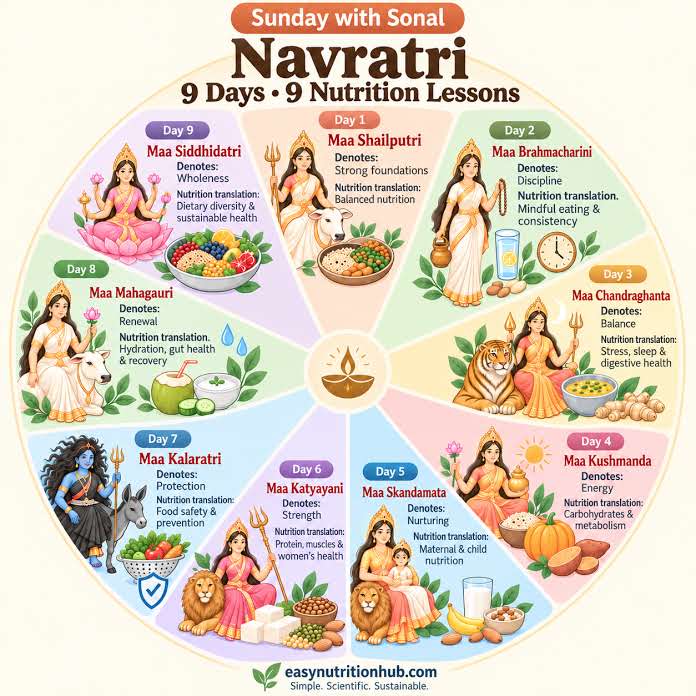
What follows is my contemporary nutritional interpretation of these qualities — a symbolic bridge between cultural understanding and established principles of nutrition and public health.
It is not a claim that the nine forms were originally intended to represent nine scientific dietary concepts.
Nine Forms of Shakti, Nine Nutritional Interpretations
| Day and Maa Durga | What she symbolises | My nutritional interpretation |
|---|---|---|
| 1. Maa Shailputri | Stability and strong foundations | Balanced nutrition: Build health on adequacy, not restrictive diets |
| 2. Maa Brahmacharini | Discipline and perseverance | Mindful eating: Consistency matters more than perfection |
| 3. Maa Chandraghanta | Courage and inner balance | Gut–brain health: Stress, sleep and digestion are interconnected |
| 4. Maa Kushmanda | Creation and energy | Energy metabolism: Nourish the body; understand rather than fear carbohydrates |
| 5. Maa Skandamata | Motherhood and nurturing | Maternal and child nutrition: Nourishing generations begins with caring for mothers |
| 6. Maa Katyayani | Strength and courage | Women’s health: Protein, muscle strength and micronutrient adequacy matter |
| 7. Maa Kalaratri | Protection and fearlessness | Food safety: Safe food is fundamental to good nutrition |
| 8. Maa Mahagauri | Purity and renewal | Restoration: Hydration, digestive health and recovery |
| 9. Maa Siddhidatri | Fulfilment and completeness | Dietary diversity: No single superfood replaces a balanced, sustainable diet |
Nutritional interpretations are contemporary symbolic connections, not scriptural or historical scientific claims.
Where Tradition Meets Science
What makes these connections interesting is that several reflect important principles of modern nutritional science.
1. Nourishment is more than calorie counting. The World Health Organization identifies adequacy, balance, moderation and diversity as four foundations of healthy diets (WHO, 2026). Good nutrition begins by meeting the body’s requirements, not simply eating less.
2. A woman’s strength deserves scientific attention. NFHS-5 (2019–21) reported anaemia in approximately 57% of Indian women aged 15–49 years (MoHFW, 2022). This reminds us why women’s nutrition, micronutrient deficiencies, muscle health and access to healthcare must remain public-health priorities.
3. Fasting is not automatically detoxification. Religious fasting has spiritual and cultural significance. However, its metabolic effects depend on the actual dietary pattern. In a 12-month randomised trial, adding time-restricted eating to calorie restriction did not significantly improve weight loss compared with calorie restriction alone (Liu et al., NEJM, 2022). We cannot directly equate that intervention with Navratri fasting, but it challenges the idea that fasting automatically delivers exceptional metabolic benefits.
4. Good nutrition is a food-systems issue, too. The ICMR–NIN Dietary Guidelines for Indians (2024) emphasise dietary diversity, while WHO guidance highlights food safety as an essential component of healthy eating. A full plate is not always a nourishing plate, and nutritious food must also be safe, affordable and accessible.
A Thought I Want to Leave You With
As women, we are often appreciated for how much we can manage.
How tirelessly we work. How well we care for our families. How much we can accomplish without complaining. But somewhere along the way, have we started confusing exhaustion with strength and self-neglect with dedication?
I find the symbolism of Navratri especially beautiful because it reminds us that strength has many expressions. Sometimes it is courage. Sometimes perseverance. Sometimes protecting someone. Sometimes nurturing a child.
And sometimes, it is simply allowing yourself to rest. As I restart Sunday with Sonal, I want this space to be about more than nutrients, calories or dietary rules.
I want it to explore food as a connection between science, culture, human behaviour, public health and everyday life.
Because true nourishment is not only about what reaches our plate. It is also about the choices, relationships and environments that shape our health.
This Navratri, while we pray for strength, prosperity, wisdom and protection, perhaps we can make one more quiet commitment:
To nourish those who nurture us. To protect our health as carefully as we protect our loved ones. And to remember that rest, too, is a form of strength.
We celebrate Shakti in the Goddess. Let us also learn to recognise, protect and nourish the Shakti within ourselves.
This Navratri, don’t just worship Shakti. Nurture the Shakti within.
Sunday with Sonal
Simple. Scientific. Sustainable
References
- World Health Organization. Healthy Diet (2026).
- ICMR–National Institute of Nutrition. Dietary Guidelines for Indians (2024).
- Liu D, et al. Calorie restriction with or without time-restricted eating in weight loss. New England Journal of Medicine (2022). DOI: 10.1056/NEJMoa2114833
- Ministry of Health and Family Welfare, Government of India. NFHS-5 Anaemia Findings (2022).
- WHO. Five Keys to Safer Food Manual (2006).
- WHO. Guideline for Complementary Feeding of Infants and Young Children 6–23 Months (2023).
- Morton RW, et al. Protein supplementation and resistance training-induced gains in muscle mass and strength. British Journal of Sports Medicine (2018).
- UNESCO. Garba of Gujarat: Representative List of the Intangible Cultural Heritage of Humanity (2023).
About the author: Dr. Sonal Gupta Jain, PhD, Public Health Nutritionist.

Leave a Reply